Monday, February 18, 2019

A Closer Look: "The Old Sewing Machine" (1863)

Today we will be taking a closer look at a steel engraving published in  Godey's January 1863 titled “The Old Sewing Machine” available on archive.org. I was once told that engravings like this one were the Polaroids of the 19th century, showing the everyday moments that weren't captured in photographs. I can't say whether this is true, or if these images are as romanticized as the often staged portraits of the poor and working class, but it does give us one more source for exploring day-to-day life.


In  this image a young woman is sewing what appears to be a men's shirt by candlelight.  Her poverty is immediately evident, as the setting is anything but opulent. The rough lumber of the sloping ceiling and chipping plaster on the walls demonstrate that this is not a room made for comfort, and she is dressed in a very plain fashion. Most likely, she is a servant, tucked away in an attic bedroom.


She sits on a small wooden stool in front of her bed: a folding, tressel. Described in An Encyclopedia of Domestic Economy (1855) as "one of the cheapest made [bedsteads]... [it] has the great convenience of being easily put aside... consisting merely of two frames connected by the sacking... there is no better bedstead for men servants or young people... they may be had complete for less than £1." Available on archive.org. On the bed is a mattress covered with a striped tick, and likely stuffed with a cheaper filling such as straw.


On the mattress sits a wide, shallow basket overflowing with fabric and two spools of white thread. Further back a candlestick with large, round base, finger loop handle and thumb tab sits on what appears to be an un-decorated bandbox with looped handles. On the floor are a simple, unmatched pitcher and basin.


The woman in questions wears a plain, solid colored dress, presumably of a hard wearing material like wool. There are several patches visible on the skirt. From beneath her sleeves poke white cuffs, and around her neck hangs a checked kerchief. Further back, hanging on the wall are what appear to be a slatted sunbonnet and a cloak or shawl. Her hair is pulled back in a low bun with the sides swooping over her ears.  She squints at her sewing in the low light, while hanging her head in apparent exhaustion.


In March of the same year, in the section "Godey's Arm-Chair" the writer states ""The New Sewing-Machine" is also published in the number, a companion plate to the "Old Sewing-Machine" in January number. Our subscribers may make the comparison. The old sewing-machine we rather prefer in some respects, but the new one is cheap at the price."
Both plates appear to be signed "Lauderbach," and were possibly made by James W. Lauderbach of Philadelphia.

Sunday, September 2, 2018

Natural Dyes in the Mid-19th Century

Natural dyes generally come in two forms, organic dyes and mineral pigments. Organic dyes, with the exception of indigo, would not readily stick to cotton fabric without the helps of mordants for organic dyes (mineral salts such as copper, aluminum, tin and iron) and protein-binding for mineral dyes (using albumin from eggs for gluten from wheat) These mordants helped the dyes last through washing and reduced fading in light, and also functioned as a way of tinting the material to slightly different hues. None the less, cotton remained the fabric most prone to fading, which is why wool and silk are found more often in solid colors, while cotton was limited to patterns that could hide any irregularities in color.

I would highly suggest browsing the blog Civil War Quilts, which has several posts showing examples of each dye in antique and reproduction fabrics. I have linked her posts under each dye that she has covered.

Mineral Dyes

Prussian Blue


"Prussian blue was very popular in America in the 1850s, and was first used in the United States in the early 1830s. Prussian blue was commonly used in ombre prints, prints which featured a gradation from light to dark."-quiltindex.org

IndiaMART

Manganese Bronze

"Manganese dyes were responsible for a deep, rich brown and was often used in floral patterns. Manganese dyes have been used in quilts since prior to 1820, however, they were often fugitive. Manganese dyes are often responsible for serious damage to the cloth and other adjacent dyes." -quiltindex.org

Kremer Pigmints

Chrome Yellow


Chrome yellow is composed of lead(II) chromate (PbCrO4).

"[Chrome] yellows were popular in the period from about 1860 to 1880 and were produced, often in the home, from highly toxic chemical dye powders. Chrome yellows are brighter than butterscotch, another popular yellow from the same period." -quiltindex.org

Chrome Orange or Cheddar

Civil War Quilts blog post on chrome orange.

"Chrome orange is a range of orange pigments, which consists of lead(II) chromate and lead(II) oxide." -wikipedia


Best Guesses

Manganese Brown

 Le Bon Ton, April 1859. LAPL Visual Collections.

 Magasin des Demoiselles, January 1859. LAPL Visual Collections. 

Chrome Yellow


Le Moniteur de la Mode, 1855. University of Dusseldorf. 

Moniteur de la Mode, September 1862. LAPL Visual Collections.

Chrome Orange/Cheddar

1865-1875 Silk Visiting Dress. Met Museum.
1865-67 House of Worth Orange Silk Evening Dress with White Embroidery. (Kent State Museum)

Prussian Blue

Le Follet, May 1862. LAPL Visual Collections.
Allgemeine Moden-Zeitung, 1862. University of Dusseldorf.
Le Follet, May 1861. LAPL Visual Collections.


Sources:
http://www.quiltindex.org/~quilti/wiki/index.php/Fabric_Dating_References
https://web.archive.org/web/20150316215218/http://info.fabrics.net/madder-minerals-and-indigo-cotton-dyeing-in-the-18th-19th-century/

Griddle Cakes of Unbolted Wheat (1847)

Today's recipe come from "Miss Beecher's domestic receipt book : designed as a supplement to her treatise on domestic economy." Originally published in 1847, the 3rd edition was in print until 1860. 

Here is a transcription of the recipe which can be found on page 95 of the text.

Griddle Cakes of Unbolted Wheat
A quart of unbolted wheat, and a teaspoonful of salt. Wet it up with water or sweet milk, in which is disolved a teaspoonful of saleratus. Add three spoonfuls of molasses. Some raise this with yeast, and leave out the saleratus. Sour milk and saleratus are not as good for unbolted as for fine flour.
These are better and more healthful cakes than buckwheat.

Modern interpretation:

4 cups of whole wheat flour
1 tsp salt
4 cups water or milk*
1 tsp of baking soda
3 tbsp of molasses

*sweet milk is regular milk, sour milk is buttermilk

I prepared this recipe by cutting it in four (so 1 cup of flour, 1/4 tsp of salt, etc.) This makes 5 or 6 medium pancakes. I have used water instead of milk every time I have made it, just for convenience. In the past, I have substituted brown sugar for molasses such that I can have all the dry ingredients pre-mixed and just add water.

I have not included instructions for making it up with yeast, as I have never tried it. Let me know if you do!

This flour to water ratio makes a thinner pancake, which seems to have been the norm at the time. It is half way between modern fluffy pancakes and a crepe. But, as the actual amount of liquid is not specified, feel free to experiment and find what works for you!

Top with molasses, maple syrup, or whatever you prefer! This is a wonderfully simple recipe that is tasty and easy to prepare. Definitely a win in my book!


Sunday, February 5, 2017

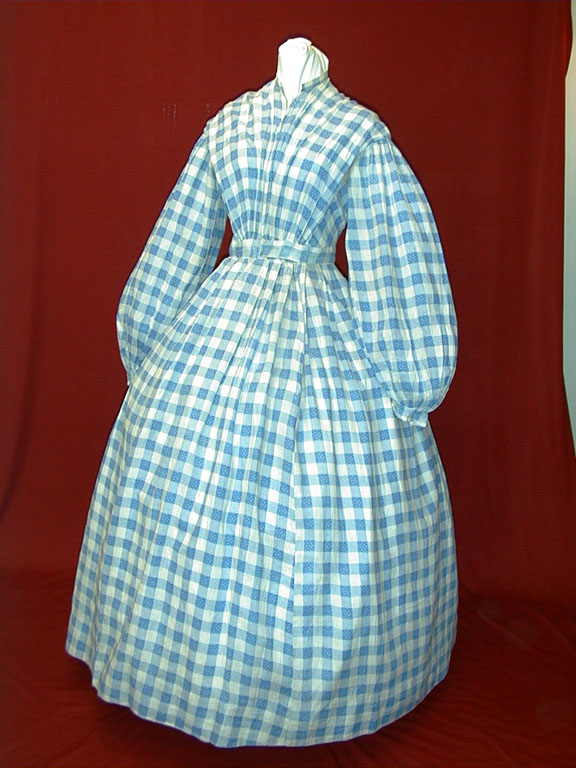
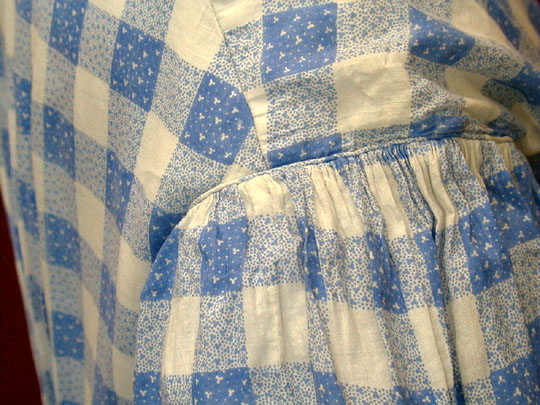
1860s Fabrics Part 1: Gingham

Gingham: 
checkered pattern where the checkers are square. The pattern is usually two colors, one of which is white. The stripes of color are the same width, one darker than the other and darker still where they overlap.

Period Photographs
It is difficult to differentiate between different types of plaid/checkers in photographs, but here are some "best guess" examples. Click on the photo to go to the original source.

The Barrington House Collection


The Barrington House Collection

The Barrington House Collection

The Barrington House Collection

The Barrington House Collection


Photo Print for Sale on Ebay
The Graceful Lady collection of CDVs of Children's Clothing

Original Dresses
Dress and wrapper worn by Mary Todd Lincoln. Chicago Histroy Museum.
Cotton dress. 1860-1865. Ohio State University Costume Collection

Same dress up close

The Graceful Lady collection of wool and cotton day dresses
Same dress up close 

Child's dress, c. 1860. Augusta Auctions

The same dress up close

Silk taffeta dress, c, 1865. FIDM Museum.

Conclusions
Gingham fabric seemed to be used in both lady's and children's clothing. Patterns were both large and small scale, and found on both cotton and silk fabric. The original dresses I found all used shades of blue or green, but I can't say for certain if this was a common trend.

Thursday, February 2, 2017

Civil War Era Knitting Patterns Part One

In this post I will be highlight some knitting patterns from 1860s sources such as lady magazines, as well as catalog modern reproductions of each project that can be found around the web. For the description of the yarn, I provided (what I think) is the standard weight and what they were called on Ravelry or any blog posts I found.

I have posted some pictures of peoples completed projects on this page. If you click on the picture it will take you to their blog post. Many of these bloggers have provided modern "translations" of the pattern that are much easier to follow than the original instructions.


Lilac and white with navy ribbon by "One More Stitch.". Made using 2.75 mm/US Size 2 Needles and 880 yards (4 skeins) of yarn.
My reproduction


White and blue by "One More Stitch." Made using 6.5 mm/US 10 & 1/2 needles and 848 yards (8 skeins) of  yarn.

Oatmeal and brown by "One More Stitch." Made using  6mm/US Size 10 needles and 1,395 yards (3 skeins) of yarn.

Sunday, January 29, 2017

Synthetic Dyes in the Mid-19th Century

The invention and eventual mass production of the synthetic dye Mauveine in 1856 by William Henry Perkin lead to an explosion of colorful fabrics in the mid-19th century. In this blog post I'll showcase some of the dyes that were created as well as examples of each when they could be found.

It should be noted that not all of the garments in the post have been proven to be colored by the given given dye. I did my best to find examples that had been labeled as such by museums or other bloggers more knowledgeable than myself. A blog post by the Dreamstress was especially useful.

As well, there very well may have been some synthetic dyes from the mid-19th century that I did not mention. I did my best to find as many dyes invented/patented in the 1850s-60s as I could, but there are not exactly a plethora of resources available on the topic. If you notice anything missing from this page, please let me know and I will add it.

Mauveine-1856


  • "Dyes silk direct a reddish violet. Cotton requires a mordant of tannin and tartar emetic." 
  • Also known as "Rosolane (Poirrier), Chrome Violet, Mauve, Aniline Purple, Indisin, Perkin's Violet, Aniline Violet, Violein, Purpurin"
    • A Dictionary of the Coal Tar Colours page 61
Fashion Plate, France, 1864. Victoria and Albert Museum.


Dress, England, 1862-1863. Science Museum/Science & Society Picture Library


Magenta-1859

  • "Dyes wool and silk from neutral baths. Cotton requires mordanting with tannin and tar-tar emetic. Fine blue-red shades are obtained, which are fast to light or washing."
  • Also known as Verguin's Fuchsine, "Fuchsin, Rubin, Aniline Red, Rosein," 
    • A Dictionary of the Coal Tar Colours pages 59-60
Dress, USA, 1868-1870. Museum of Fine Arts Boston.
Dress, probably USA, 1866-1868. Philadelphia Museum of Art.

Hofman's Violet-1863

  • "The red shades of this violet... Dyes wool in a neutral bath, silk also in a neutral bath (cotton requires a tannin and antimony mordant), fine bright bluish reds, not fast to light or washing."
  • "The blue shades of Hofman's violets... dyes the fibers in the same way as the red shades, but gives pure violet shades; not fast to light or washing."
  • Also known as "Iodine Violet, Dahlia, Primula, Red Violet 5R, Extra Violet 5R, Violet R."
    • A Dictionary of the Coal Tar Colours page 56
  • "Shares the same base structure as methyl violet... [but] is redder." (Source)

Crystal Violet-1861

  • "Crystal violet is one of the components of methyl violet, a dye first synthesized by Charles Lauth in 1861. From 1866, methyl violet was manufactured by the Saint-Denis-based firm of Poirrier et Chappat and marketed under the name "Violet de Paris"." (Source)
  • Also known as Methyl Violet, Violet de Paris
Dress, England, c. 1865. Nineteenth century Australian Fashion and Textiles collection.

**Yellows**

Dress, Italy, c. 1865. Galleria del Costume di Palazzo Pitti.


Aniline Yellow-1861

  • "Dyes wool and silk red in acid baths. On washing with water the dyes fiber turns yellow. It is not fast, the colour easily volatilising when heated."
  • Also known as "spirit yellow"
    • A Dictionary of the Coal Tar Colours page 12

Martius/Napthol Yellow-1864

  • "Dyes wool and silk golden yellows, which are not fast to washing or acids."
  • Also known as "Manchester Yellow, Martius Yellow, Naphthalene Yellow, Naphthylamine Yellow, Gold Yellow."
    • A Dictionary of the Coal Tar Colours page 69
Wool dyed in a warm solution of Martius Yellow Dye and ammonium hydroxide is yellow, even after washing with water. Cotton dyed in this solution followed by rinsing, will remain white.

**Blues**

Aniline/Opal Blue-1860

  • "Dyes cotton from a soap and alumina mordant, wool and silk direct fine greenish blues; very fast to light and acids."
  • Also known as "Aniline Blue Spirit Soluble, Gentiana Blue 6B, Spirit Blue O, Night Blue."
Dress, Canada, 1863. Society for the Museum of Original Costume.


Alkali/Nicholson Blue-1862

  • "Dyes wool and silk by special method fine shades of blue; fast to acids and washing, fairly fast to light."
    • A Dictionary of the Coal Tar Colours page 9
Bodice and Belt, France, 1865-1866. Les Musees de la Ville de Paris.

Aldehyde/Aniline Green-1861


Aniline Black-1863

  • "Fabric, such as cotton, is soaked in an aqueous solution of aniline hydrochloride and an oxidizing agent, such as chromic acid. This results in a strong black color that is not lightfast."

Bismarck/Manchester Brown-1865

  • "Dyes wool and silk in neutral bath reddish brown shades; cotton requires a tannin mordant." 
  • Also known as "Phenylene Brown, Vesuvin, Aniline Brown, Leather Brown, English Brown, Gold Brown, Walnut Brown."
    • A Dictionary of the Coal Tar Colours page 28
Magdala Red-1868
  • "Dyes cotton mordanted with tannin and tartar emetc rose-red shades. Dyes silk from an acidulated soap bath fine rose-reds having weak fluorescence."
    • A Dictionary of the Coal Tar Colours page 59

Sources: